AIDA
AI Digital Assistant
This section offers details about the AI Digital Assistant (AIDA). On this page, you will find screencasts demonstrating how AIDA responds to questions and supports students in enhancing their learning experience. AIDA operates in different “roles” and in each role its behaviour and interaction style changes. Each of the buttons map to a role. Scroll below to access helpful examples.

Emily is an OU student taking the course “Take Your Teaching Online”.
She wants to dive deeper into this week’s topic and clicks the ‘Chat’ button to ask AIDA a question, seeking further explanation. This is a ‘vanilla’ role where AIDA is answering questions. AIDA then provides structured, step-by-step guidance and resources to help learners navigate course content, offering instant feedback and adaptive support to enhance comprehension and progress. To reduce hallucination, AIDA provides ‘Sources’ for all her answers, which users can click on to verify.
Through the ‘Explain’ button, AIDA offers personalised feedback, providing tailored, one-on-one support to help learners achieve their academic goals. In this role, AIDA offers feedback based on the current and previous student input, offering guidance, encouragement, and building understanding and confidence.
Emily decides to test her knowledge and understanding by asking the AI guide to challenge her. In this role, AIDA acts as a Socratic Guide, steering learners through thought-provoking questions and dialogue. This approach encourages critical thinking, self-discovery, and a deeper understanding, rather than simply providing direct answers.
Emily decides to test her knowledge and understanding by asking the AI guide to challenge her. In this role, AIDA acts as a Socratic Guide, steering learners through thought-provoking questions and dialogue. This approach encourages critical thinking, self-discovery, and a deeper understanding, rather than simply providing direct answers.
AIDA is a multimodal platform, offering users the flexibility to transform written sections into podcasts and enabling voice-activated queries. It also features full AI avatars, which allow users like Emily to delve deeper into topics through interactive exploration.
At the end of her session, Emily takes a quiz to assess her understanding, reinforce her learning, and identify areas where she might need more support. AIDA can generate quizzes instantly based on the current focus of the conversation, ensuring that the questions are always relevant and tailored to Emily’s needs. Quizzes also encourage active recall and engagement with the material.
To reinforce her learning, Emily wishes to revise her knowledge using flashcards. These enhance memory retention and recall through active engagement, repetition, and spaced repetition techniques. She can either ask questions or provide statements to master concepts efficiently.
Finally, Emily enables dynamic text, which adapts content based on user interaction, context, or data inputs. AIDA is able to rephrase, simplify, or expand sentences to make them clearer or more comprehensive to Emily.
Follow Emily’s journey to see how the AI Digital Assistant can transform your learning experience!
AIDA in Action: How AIDA keeps learners longer, and smarter
Since 2023 we have tracked thousands of student sessions; the newest figures show longer dwell-time and sharper recall for regular AIDA users.
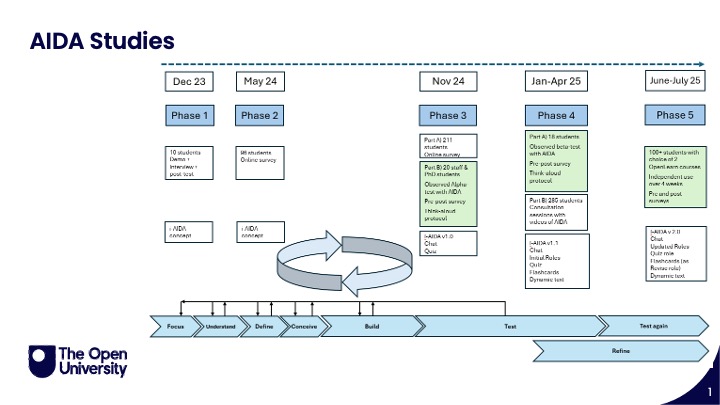
We have been running a variety of studies involved students engaging with AIDA since late 2023.
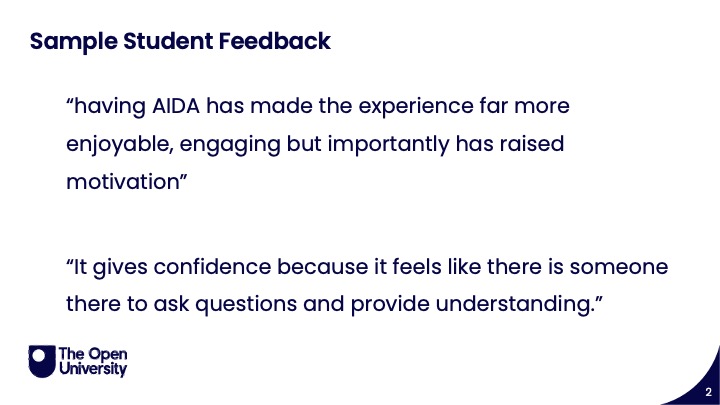
There are is a percentage of students who do not like AI but many give positive feedback.
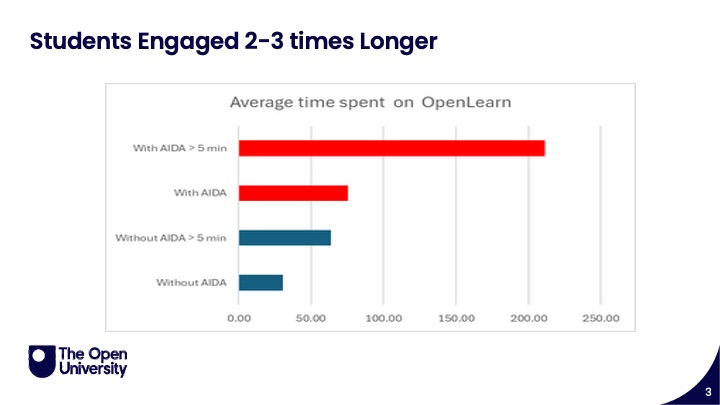
A study conducted in summer 2025 showed that students with AIDA who spent more than five minutes on the platform remained engaged for two to three times longer.
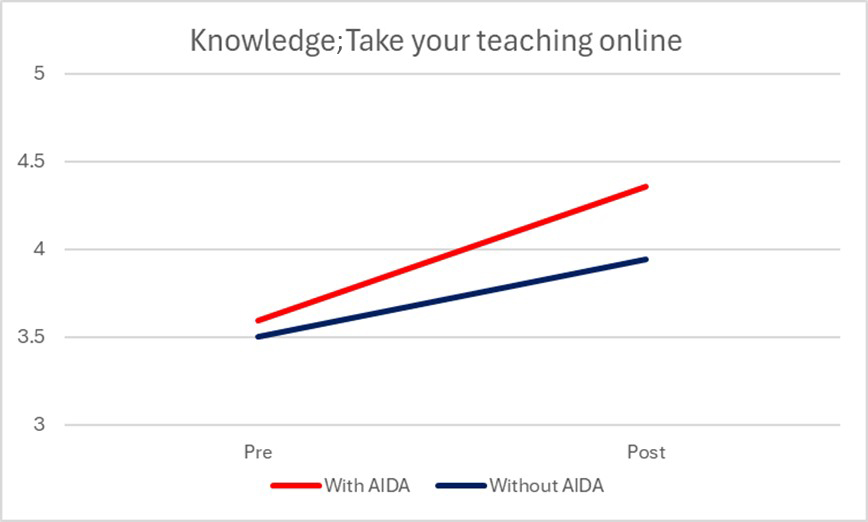
The summer 2025 study also showed significant gains in knowledge retention in students using AIDA.
The AIDA prototype has been developed collaboratively by:
KMi
Contact: John Domingue john.domingue@open.ac.uk
Tanay Aggarwal
Vaclav Bayer
Audrey Ekuban
Joseph Kwarteng
John Lee
Alexander Mikroyannidis
Iman Naja
Riccardo Pala
Nancy Pontika
Chris Sanders
Nirwan Sharma
Aisling Third
IET
Contact: Tim Coughlan tim.coughlan@open.ac.uk
Duygu Bektik
Emily Coughlan
Peter Devine
Chris Edwards
Christothea Herodotou
Bart Rienties
Felipe Tessarolo
Ben Tidman
Thomas Ullmann
Digital Services, Learning Systems
Zoe Gipson
Damian Hippisley
Thanh Le
Alex Monaghan
Firnaz Nagoorthamby
Neil Ridge
Open Learn, Learner and Discovery Services
Simon Ashby
Raihanah Begum